Simple Inventory
This recipe demonstrates how the DASDAE inventory can be used with a simple deployment. In this scenario, the interrogator is connected to a telemetry cable (with unknown geometry/coupling) that then connects to a trenched cable through two E2000 connectors housed in an E2000 coupler. The sensing fiber runs 300 m east, turns north for 120 m, then leaves the trench and continues 300 m east on the surface (Figure 1).
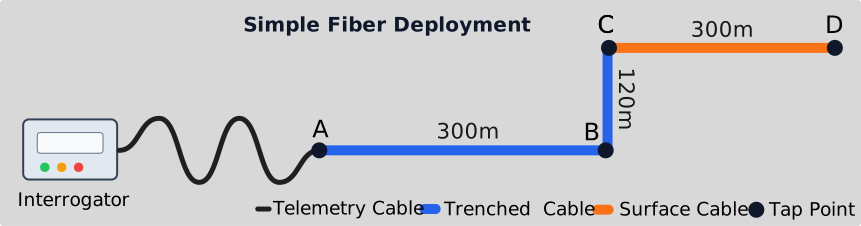
This page is an illustrative inventory example for the proposal. The exact Python API names may shift as the DASDAE inventory implementation evolves.
Field Notes
The tap test defines four points along the sensing fiber. Coordinates are WGS84 latitude, longitude, and elevation with values centered in the gardens of Versailles (just for fun).
| Point | Description | Optical Distance (m) | Latitude | Longitude | Elevation (m) |
|---|---|---|---|---|---|
| A | Start of sensing fiber after E2000 coupler | 50 | 48.807461 | 2.103905 | 115 |
| B | 90-degree bend in trenched section | 350 | 48.807461 | 2.108000 | 115 |
| C | Cable exits trench and becomes loose | 470 | 48.808539 | 2.108000 | 115 |
| D | End of loose surface-laid section | 770 | 48.808539 | 2.112095 | 115 |
The deployment uses a telemetry (lead-in) cable to connect to a separate sensing cable.
| Cable | Role | Fiber Type | Construction | Notes |
|---|---|---|---|---|
| Telemetry lead-in | Interrogator to E2000 coupler | Single-mode | Armored patch cable | Not used for sensing |
| Solifos BRUsens DAS AC3 | DAS sensing fiber | DAS sensing cable | Armored sensing cable | Trenched from A-C, loose from C-D |
Build The Inventory
Start by transcribing the field notes into a table. This gives the inventory a single source for geometry and distance intervals. In practice this would be read from a CSV.
import pandas as pd

tap_points = pd.DataFrame(
    {
        "point": ["A", "B", "C", "D"],
        "description": [
            "Start of sensing fiber after E2000 coupler",
            "90-degree bend in trenched section",
            "Cable exits trench and becomes loose",
            "End of loose surface-laid section",
        ],
        "distance": [50.0, 350.0, 470.0, 770.0],
        "latitude": [48.807461, 48.807461, 48.808539, 48.808539],
        "longitude": [2.103905, 2.108000, 2.108000, 2.112095],
        "elevation": [115.0, 115.0, 115.0, 115.0],
    }
).set_index("point")

tap_points["coordinates"] = list(
    zip(tap_points["longitude"], tap_points["latitude"], tap_points["elevation"])
)
total_optical_length = tap_points.loc["D", "distance"] - tap_points.loc["A", "distance"]
Acquisition
The acquisition describes the interrogator and the configuration used to produce a data stream.
import dascore.core.inventory as inv

interrogator = inv.Interrogator(
    manufacturer="Example Instruments",
    model="DAS-1000",
    serial_number="RUDAS88",
)

acquisition = inv.Acquisition(
    code="RAW",
    location_code="",
    data_category="DAS",
    data_type="strain",
    data_units="strain",
    interrogator=interrogator,
    start_time="2026-06-01",
    sample_rate=250.0,
    gauge_length=2.0,
    spatial_interval=1.0,
    distance_map=inv.DistanceMap(instrument_distance=(0.0,), distance=(0.0,)),
    software_version="v0.2.1",
)
Cables And Fibers
The lead-in cable, sensing cable, and E2000 coupler are independent resources. The optical path can refer to them without duplicating metadata.
The inventory implementation generates unique internal IDs automatically.
telemetry_cable = inv.Cable(
    name="Telemetry lead-in cable",
    fiber_count=1,
    description="Armored patch lead-in cable from interrogator.",
)

sensing_cable = inv.Cable(
    name="Solifos BRUsens DAS AC3 cable",
    manufacturer="Solifos",
    model="BRUsens DAS AC3",
    fiber_count=4,
)

e2000_coupler = inv.Enclosure(
    name="E2000 coupler",
    enclosure_type="coupler",
)
Optical Path
The optical path describes the components encountered by the light, along with geometry, coupling, and annotations that can later be projected onto patch coordinates.
Components
telemetry_lead = inv.FiberSegment(
    name="Telemetry lead-in fiber",
    optical_length=tap_points.loc["A", "distance"],
    fiber_standard="OS2",
    fiber_color="yellow",
    description="Not used for sensing.",
    container=telemetry_cable,
)
lead_in_connector = inv.Connector(
    name="Telemetry lead-in E2000 connector",
    connector_type="E2000",
    container=e2000_coupler,
)
sensing_connector = inv.Connector(
    name="Sensing cable E2000 connector",
    connector_type="E2000",
    container=e2000_coupler,
)
sensing_fiber = inv.FiberSegment(
    name="Solifos BRUsens DAS AC3 sensing fiber",
    optical_length=total_optical_length,
    fiber_type="das_sensing_cable",
    fiber_standard="Solifos BRUsens DAS AC3",
    buffer_type="armored_sensing_cable",
    fiber_color="blue",
    container=sensing_cable,
)
Geometry
east_trench = inv.Geometry(
    name="East trench",
    distance=(50.0, 350.0),
    coordinates=(tap_points.loc["A", "coordinates"], tap_points.loc["B", "coordinates"]),
)
north_trench = inv.Geometry(
    name="North trench",
    distance=(350.0, 470.0),
    coordinates=(tap_points.loc["B", "coordinates"], tap_points.loc["C", "coordinates"]),
)
surface_run = inv.Geometry(
    name="Surface run",
    distance=(470.0, 770.0),
    coordinates=(tap_points.loc["C", "coordinates"], tap_points.loc["D", "coordinates"]),
)
The 50 m telemetry lead-in has no survey, so it stays uncovered.
Coupling Conditions
trenched = inv.CouplingCondition(
    start_distance=50.0,
    end_distance=470.0,
    coupling_type="trench",
    medium="soil",
    attachment="direct_burial",
)
loose = inv.CouplingCondition(
    start_distance=470.0,
    end_distance=770.0,
    coupling_type="surface",
    attachment="loose",
)
Annotations
trenched_zone = inv.OpticalPathAnnotation(
    start_distance=50.0, end_distance=470.0, group="zone", value="trenched"
)
loose_zone = inv.OpticalPathAnnotation(
    start_distance=470.0, end_distance=770.0, group="zone", value="loose"
)
Assemble The Path
optical_path = inv.OpticalPath(
    name="Simple DAS experiment",
    start_time="2026-06-01",
    optical_components=(
        telemetry_lead,
        lead_in_connector,
        sensing_connector,
        sensing_fiber,
    ),
    geometry=(east_trench, north_trench, surface_run),
    coupling=(trenched, loose),
    annotations=(trenched_zone, loose_zone),
).check()
Inventory
The fiber array links the acquisition and optical path into one patch-resolvable observing identity.
fiber_array = inv.FiberArray(
    code="SIMP",
    name="Simple trench array",
    start_time="2026-06-01",
    acquisitions=(acquisition,),
    optical_paths=(optical_path,),
)

network = inv.Network(
    code="XX",
    name="Simple example network",
    fiber_arrays=(fiber_array,),
)

inventory = inv.Inventory(
    networks=(network,),
)
The shareable resources (cable, enclosures) can be manually added to the Inventory’s resources, but if not, they will be populated automatically when the inventory is created.